ISO 216 · THE SHEET
Paper that halves neatly
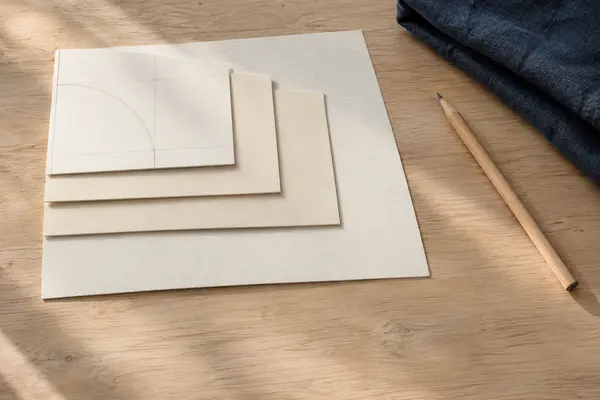
A0 is one square meter. Halve it and you get A1, then A2, A3 and A4, each the same shape.
Why the shape holds doodledraft™
THE STANDARDS BEHIND DRAWING BY HAND
Every neat drawing rests on three quiet standards.
Try the scale check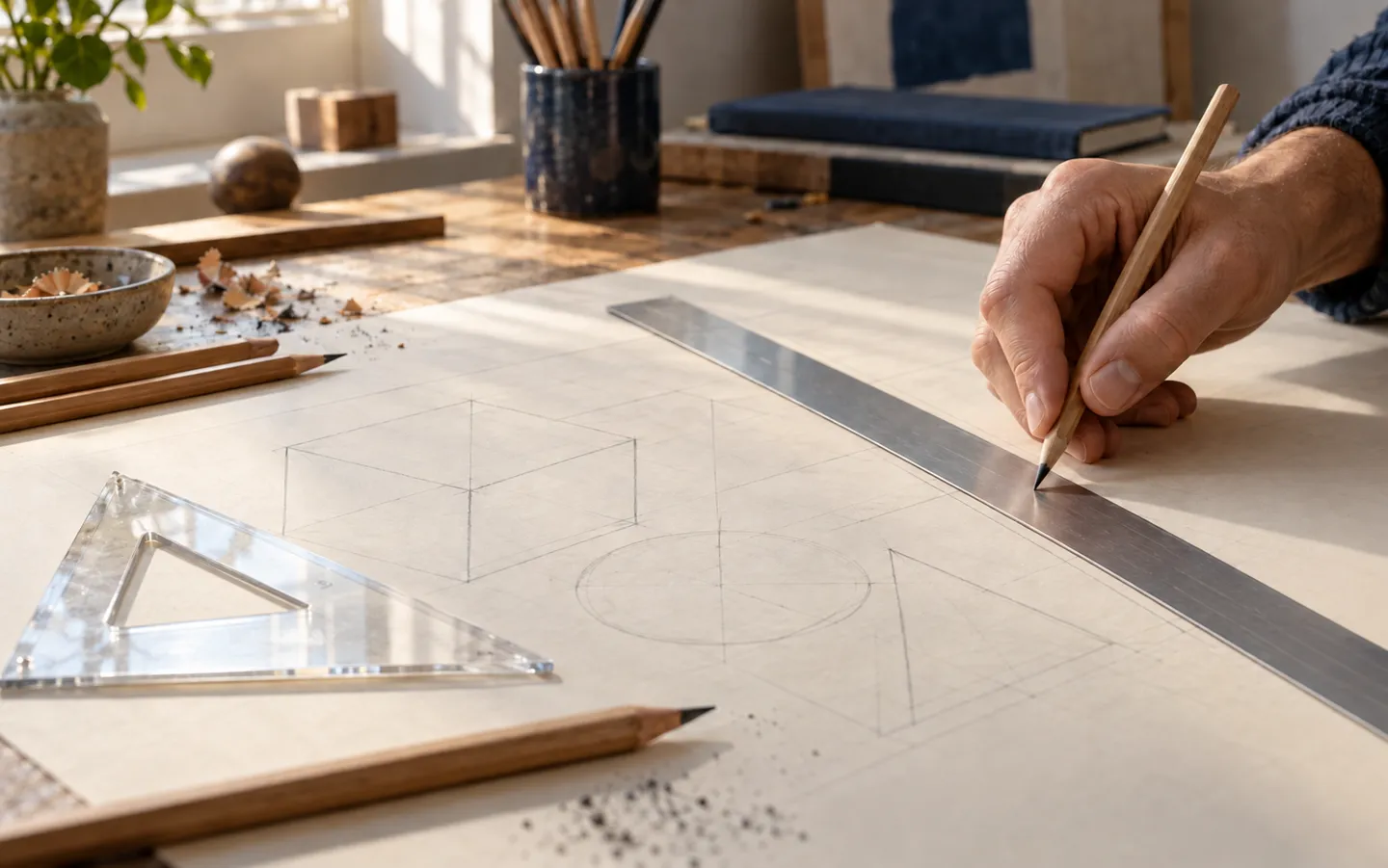
1 : 20draw to scale
The sheet comes in sizes that halve perfectly. The pencil is graded from hard and pale to soft and black. And the drawing sits at a recognized scale, so a meter always means the same on paper. Here is how each one works, in plain English.
Plain English, with the sources linked.
At a glance
1 m² to 1/16 m²
From A0 down to A4
A0 measures 841 × 1189 mm and has an area of one square meter. Four halvings later, A4 is 210 × 297 mm, a sixteenth of the area but exactly the same shape, because the sides keep the ratio 1 : √2.
PAPER · ISO 216
0.35 to 0.25 mm
Standard technical pen widths
Pen widths run 0.13, 0.18, 0.25, 0.35, 0.5, 0.7, 1.0, 1.4 and 2.0 mm, each about √2 apart. Reduce an A3 drawing made with a 0.35 mm pen to A4 and you can carry on with the 0.25 mm pen.
PENS · THE SAME STEP
THE SQUARE ROOT OF TWO
The A series and technical pen widths
both step by the same factor, about 1.414.
That is why a drawing can move between sheet sizes on a photocopier without stretching or blank margins: shrinking by about 71% (one divided by √2) turns each size into the next one down.
A QUICK SCALE CHECK
Pick one of the reduction scales recommended in ISO 5455 and see how long a one-meter line becomes, and how much of the real world fits along the long side of an A3 sheet.
The bar shows the drawn meter against its full size. Simple arithmetic: drawn length = real length ÷ the scale number.
THE TOOLKIT
Sheet sizes, pencil grades and scales
are shared conventions, not personal taste.
ISO 216 · THE SHEET
A0 is one square meter. Halve it and you get A1, then A2, A3 and A4, each the same shape.
Why the shape holdsH · F · B · THE PENCIL
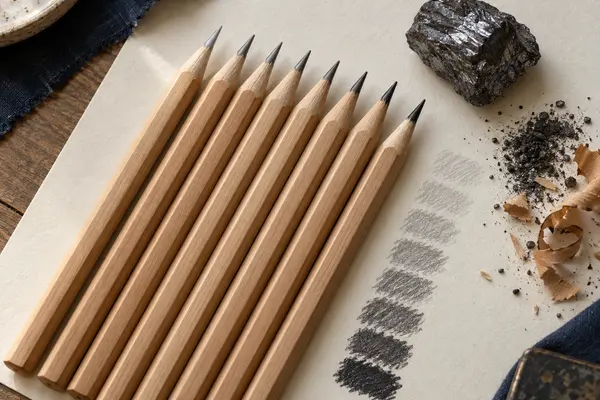
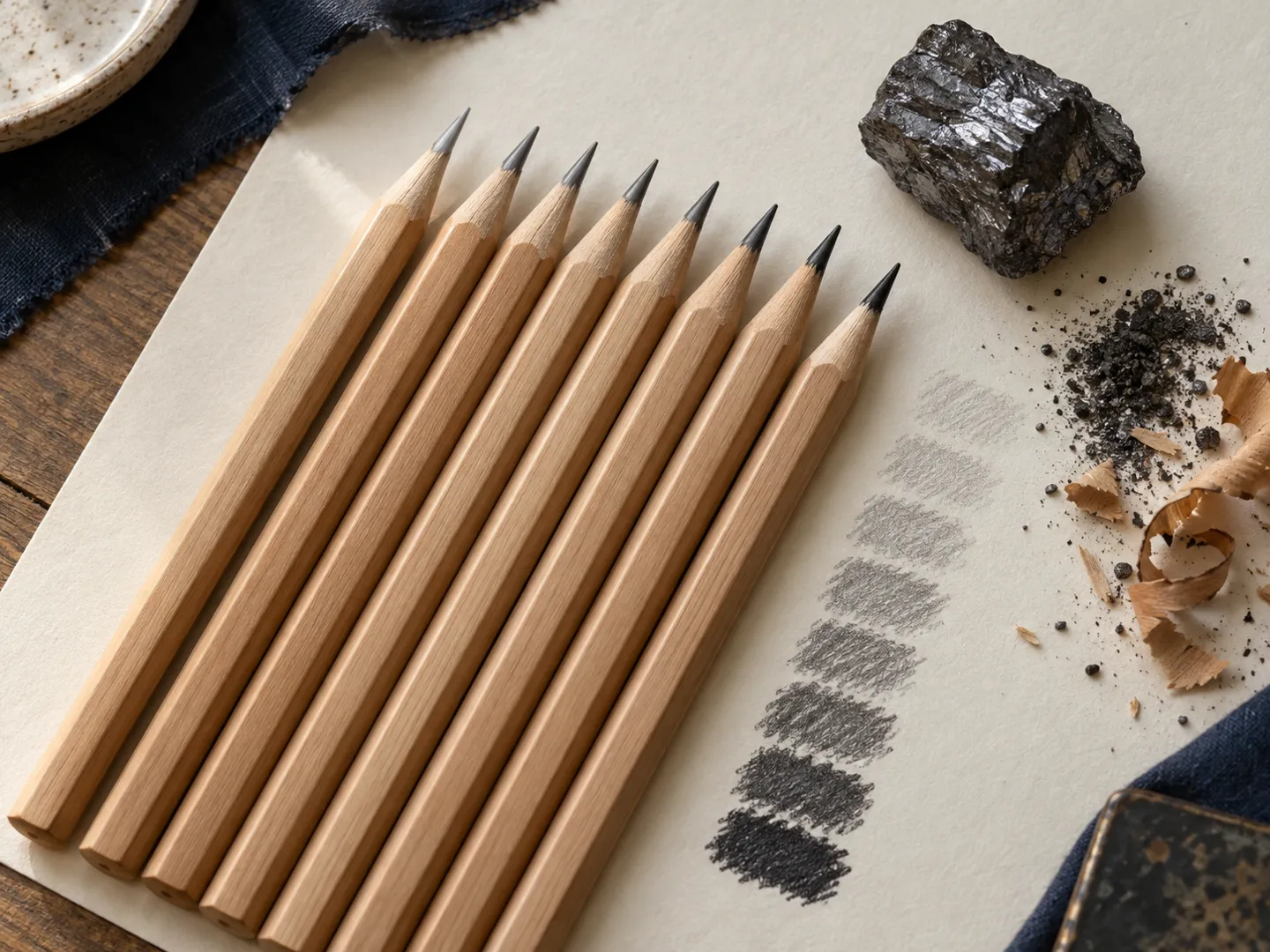
H for hardness, B for blackness, F for fine point. Hard grades draw pale, crisp lines; soft grades draw dark ones.
Where graphite came fromISO 5455 · THE SCALE
Recommended scales such as 1:5, 1:20 and 1:50 shrink real objects by fixed, easy-to-read steps.
Try a scale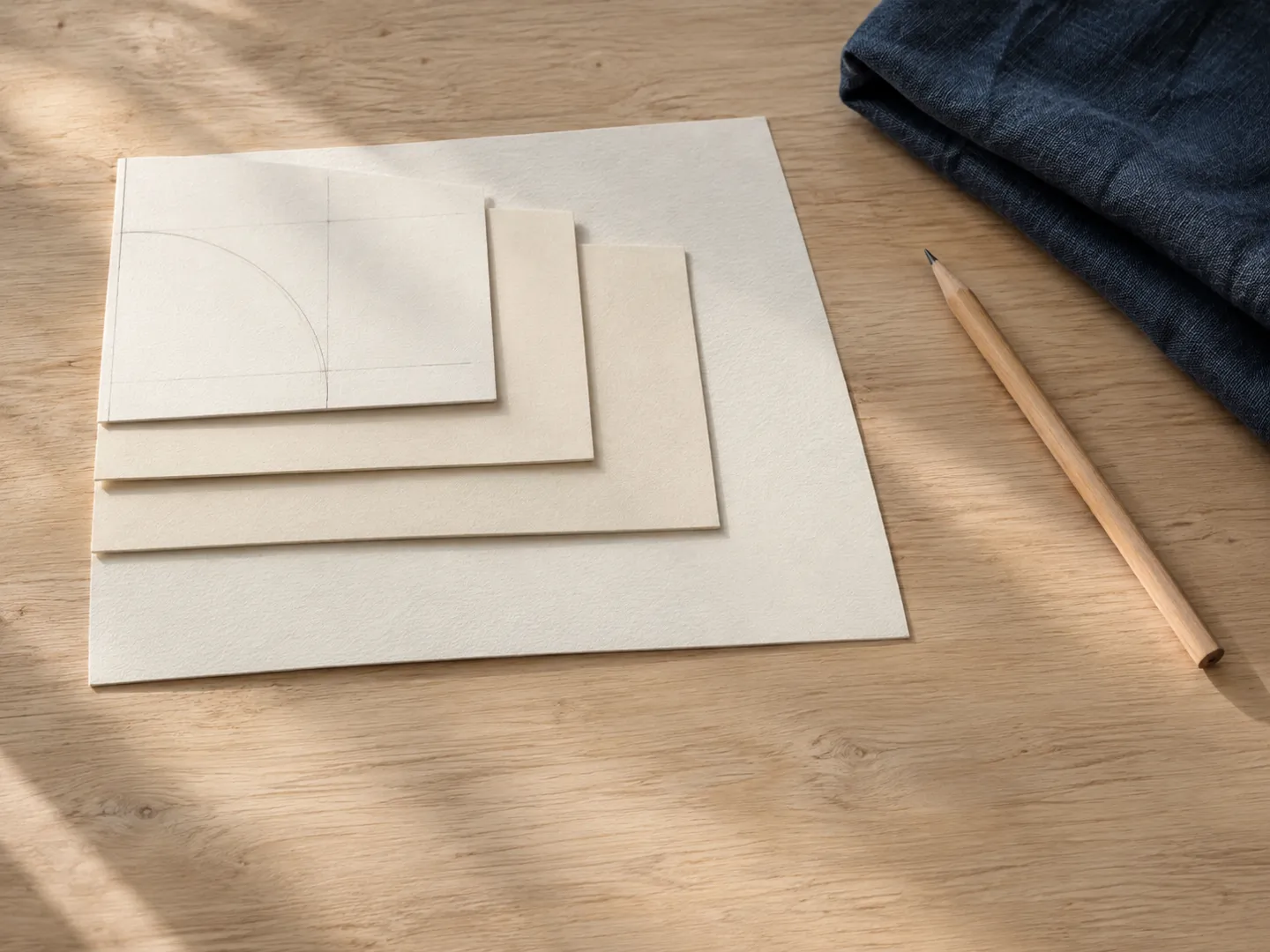
START A DRAWING
Measure the longest thing you need to draw, divide by a standard scale, and check it fits the sheet with room for a margin.
ISO 5455 designates a scale as the word SCALE followed by the ratio, for example SCALE 1:20. Anyone can then measure from your sheet.
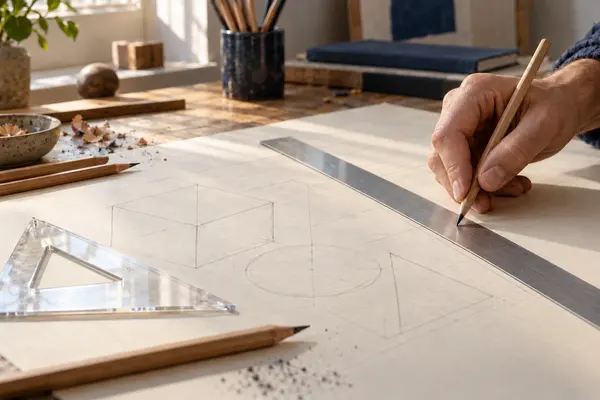
Lay out guide lines with a harder H grade that barely marks the paper, then go over the final lines with a softer HB or B.
If the drawing may be reduced from A3 to A4, use line widths one step apart, such as 0.35 and 0.25 mm, so the copy still reads clearly.
DRAFTING FACTS
The earliest records of graphite mining at Seathwaite in Borrowdale date from 1540-1. Historic England calls it the sole representative of graphite mining in England; the mines were abandoned in 1891.
Borrowdale graphite was so prized that in 1752 an Act of Parliament made unlawful entry into a graphite mine a crime.
In 1795 Nicolas-Jacques Conté patented a process that mixed finely ground graphite with clay and water, put the paste into narrow molds and fired it at high temperature.
Georg Christoph Lichtenberg described the √2 sheet in a letter in 1786. Germany adopted the system as DIN 476 in 1922, and it became the international standard ISO 216 in 1975.
Because A4 is a sixteenth of a square meter, a sheet of ordinary 80 g/m² paper weighs about 5 g. Paper weight and sheet count give you the weight of a document.
QUICK QUESTIONS
Short answers to the questions people ask most.
A4 is 210 × 297 mm. It comes from the ISO 216 A series, which starts with A0 at 841 × 1189 mm, an area of one square meter. Each size is half the one before, so A3 is 297 × 420 mm and two A4 sheets make one A3.
H stands for hardness, B for blackness and F for fine point. Depending on the maker there can be as many as twenty grades, from 9H, the hardest, to 9B, the softest. HB sits in the middle.
No. The core is graphite, which was historically also called black-lead, plumbago or wad. In 1795 Nicolas-Jacques Conté patented a process that mixes graphite powder with clay and water and fires it in molds.
One unit on the drawing stands for fifty of the same unit in real life, so a meter is drawn as 20 mm. The ISO 5455 standard lists recommended reduction scales such as 1:2, 1:5, 1:10, 1:20, 1:50 and 1:100.
Their sides are in the ratio 1 to the square root of two, about 1 : 1.414. Cut a sheet in half across its long side and each half has exactly the same proportions, so a drawing can be reduced or enlarged from one size to the next without empty margins.
Sources
A NAME WORTH SKETCHING
doodledraft.com is part of the DoodleSale portfolio. It isn't in an auction right now, but you can ask about leasing it.